
Marriage, Sexuality, and Unequal Freedom
The Second SexThis thread traces how marriage promises security while organizing unequal obligations, producing conflicts around sexual consent, economic dependence, domestic labor, and the possibility of an equal couple.
increasing Bearing strength in each event
 decreasing
Bearing strength in each eventdecreasingMarriage as Destiny

The Marriage Contract
Unequal Entry
Marriage is presented as women’s traditional destination, but it has a different meaning for each sex. A man may marry as one choice among others; for many women, marriage is the principal route to social standing, economic security, and adult recognition.
A Transfer of Authority
De Beauvoir traces how a woman is transferred from her father’s household to her husband’s world. Even as modern law permits greater freedom, customary expectations still assign him authority and make her adaptation to his life appear natural.
The conflict begins before the wedding: the woman is asked to choose freely within conditions that sharply restrict her alternatives. What is described as mutual union can therefore preserve an unequal structure beneath the language of consent.
The Wedding Night Ordeal

Initiation as a Test
A Sudden Passage
The wedding night can make the transition from girlhood to married life abrupt and frightening. A young woman may face sexual experience as a duty imposed by custom, while her husband approaches it with rights and expectations she has scarcely had the chance to question.
Consent and Consequence
De Beauvoir describes how the imbalance between the partners can turn defloration into an ordeal, especially when instruction is absent and the husband is clumsy or brutal. Such an experience may shape the woman’s later relation to her body, her husband, and sexual pleasure.
The conflict is not simply between ignorance and knowledge: marriage turns an intimate encounter into an institutional obligation. Where reciprocity and freedom are missing, the supposed beginning of conjugal life can instead establish fear, resentment, and frigidity.
Domesticity Without Autonomy
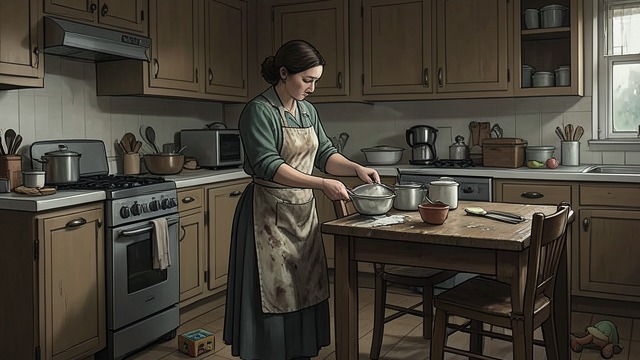
The Home as a Limit
Repetition and Maintenance
The wife is expected to preserve the home, prepare food, care for children, and maintain the continuity of family life. These tasks can require real labor, but they often produce no independent project or recognized place in the wider world.
Dependence Behind Service
Because domestic work is treated as an extension of the husband’s life, the wife’s meaning and standing remain tied to him. Her work may make the household function, yet it does not necessarily give her economic autonomy or public recognition.
The conflict is between the work she performs and the limited authority it yields. De Beauvoir portrays domesticity as a sphere in which a woman can be indispensable to others while remaining socially inessential herself.
Conjugal Love and Resentment

Intimacy Without Reciprocity
A Difficult Ideal
Marriage is often expected to unite erotic desire, friendship, economic cooperation, and lifelong fidelity. De Beauvoir argues that these aims do not automatically harmonize, particularly when the woman is required to serve while the man retains greater freedom and authority.
Boredom and Counterattack
When the spouses cease to recognize one another as independent beings, intimacy can become routine rather than exchange. The wife may respond with scenes, frigidity, jealousy, or efforts to control her husband; he may experience these as oppression while overlooking the dependency that structures their lives.
The conflict is generated not simply by individual bad faith but by an institution that promises mutual love while preserving unequal duties. De Beauvoir contrasts this with a relationship that would require two autonomous people to recognize each other freely.
The Possible Equal Couple

From Institution to Reciprocity
Marriage’s Contradiction
The chapter concludes that the established institution asks spouses to surrender freedom in exchange for security, while offering women less independence and fewer concrete opportunities. Domestic work and motherhood may bind the couple, but they cannot guarantee love or equality.
A Different Relation
A viable union would require two self-sufficient people who do not use one another as instruments or sources of justification. Their relationship could include love, sex, cooperation, and shared care without turning either partner into a master or dependent.
The conflict does not make intimacy impossible; it makes its conditions visible. Equality must become material and lived, rather than remaining a promise that conceals the wife’s subordination.
The opening argument of the married-woman chapter
The account of the traditional wedding night and early sexual initiation
The chapter’s analysis of housework and the marital household
The chapter’s discussion of conjugal love, conflict, and routine
The final argument of the married-woman chapter
